

Most of us experience the Olympics as a TV event that lasts several weeks and — depending on your level of investment in, say, figure skating — can ruin your sleep schedule for a while. But since 1912 — long before the Olympics were televised — the International Olympic Committee has commissioned a more bite-size version of nearly every edition of the Games: an official documentary that captures the highlights and celebrates the athletic achievements.
These films provide a kind of archive — especially important in a time before TV coverage. And it’s fun to watch some of those older films and see how the sports have evolved. In celebration of the Milan Cortina Winter Games, you can stream all the documentaries on the free Olympics website, or watch them on the Criterion Channel.
There are occasional gaps in the record. The I.O.C. didn’t commission a film for the 1936 Summer Games in Berlin, for instance, because the Nazi regime commissioned Leni Riefenstahl to direct. The result was “Olympia,” a stunning film for both its revolutionary techniques and for its overtly, disturbingly propagandistic images promoting the Third Reich’s racist ideals.
But most of the time, there’s an official film for the Games. Watching them, you may notice two things. Some of them are startlingly cinematic, far beyond the workmanlike coverage we expect from seeing the same action on television. And almost without fail, they tell the unflaggingly positive story promoted by the I.O.C.: that the Games are a symbol of the power of sports to bring people together and promote world peace. Excellent examples of these characteristics show up in two of the documentaries, both from the previous Winter Olympics held in Italy.
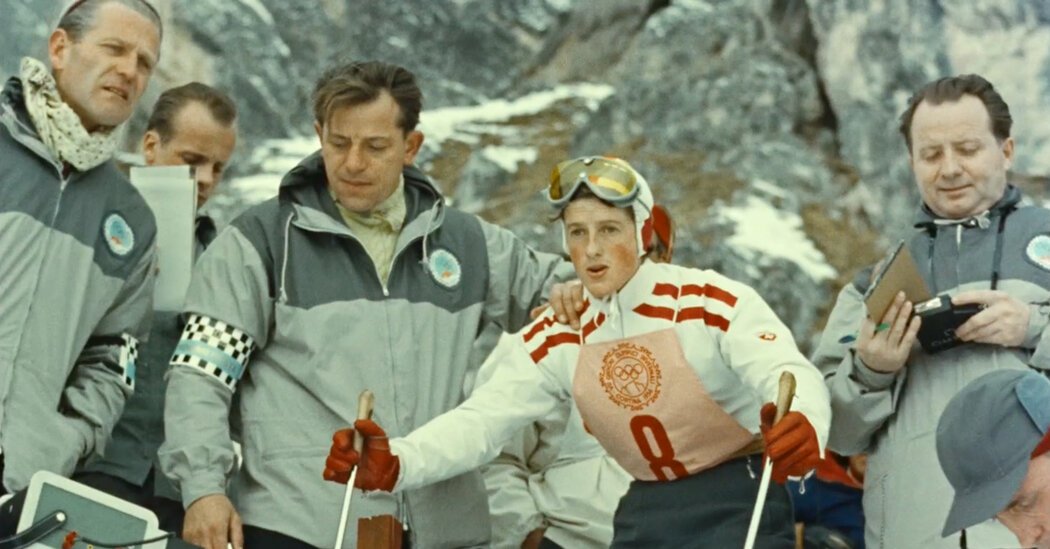
“White Vertigo,” directed by Giorgio Ferroni, chronicles the 1956 winter Games, which were also held in Cortina, one of the two cities hosting this year. Perhaps because the film had to compete with the burgeoning medium of TV, it’s uncommonly lovely, looking almost like a Technicolor extravaganza. The first few minutes meander around the mountains while a narrator comments on the beauty of nature and the village, before the athletes descend.
As the action gets going, the music is sometimes orchestral, sometimes jazzy, sometimes bordering on the avant-garde. It’s a fun movie in its own right, apart from all the sports. The reason probably has to do with the creative team: the cinematographer Aldo Scavarda would go on to shoot Michelangelo Antonioni’s masterpiece, “L’Avventura,” only a few years later. The composer Angelo Francesco Lavagnino scored, among many other movies, two by Orson Welles: “Othello” and “Chimes at Midnight.”
The “White Vertigo” approach to the Games couldn’t be more different from that of “Bud Greenspan’s Torino 2006: Stories of Olympic Glory.” This was the last Olympic film of Greenspan’s to be released before he died in 2010 (though he also co-directed one about the Vancouver Winter Olympics). The film itself is a fine enough watch, but it’s mostly interesting as an example of the director’s work. He spent most of his career making Olympic documentaries, including 10 official ones, the series “The Olympiad” and a number of shorts, including “Jesse Owens Returns to Berlin” (1966).
Greenspan’s style in the Torino film and others is familiar to us now, especially in Olympics coverage. He favored emotional, personal stories, often bringing audiences near the athletes so we could feel the tension and effort. He would include portraits and interviews to create more interest and investment. He also pioneered the use of crowd reactions to tell the story of the events.
And Greenspan was known for — and freely admitted to — ignoring scandals and negative events in favor of positivity. His entry on the 1994 Lillehammer Winter Games doesn’t mention the attack on the figure skater Nancy Kerrigan by people associated with her rival Tonya Harding. “I’ve been criticized for having rose-colored glasses,” he told The New York Times in 1996. “I say if that’s true, what’s so bad?”
That idealism made him a great match for the I.O.C., which is probably why it kept bringing him back. And that’s the echo across all of these documentaries: sports brings us together, as the I.O.C. says, and these athletes represent the pinnacles of the human spirit. Sometimes, especially in moments of geopolitical turmoil, that sentiment can feel a little forced. But when you’re watching one of these documentaries — or just enjoying a great figure skater or skier doing something nobody else has ever done — it’s hard not to get caught up in the spirit, too.