

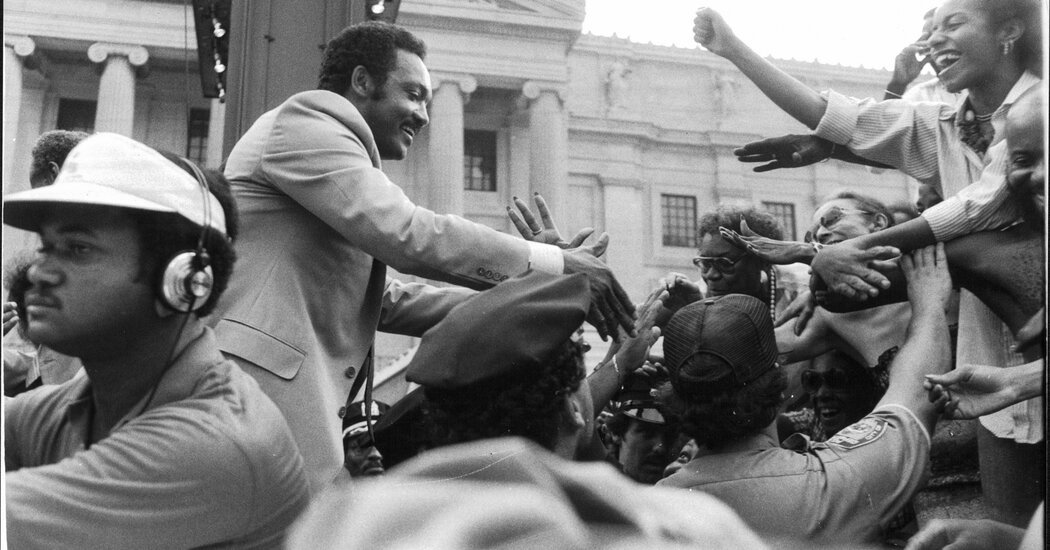

The Rev. Jesse Jackson, the civil rights crusader who died on Tuesday, was born Jesse Louis Burns on Oct. 8, 1941, in Greenville, S.C. His mother, Helen Burns, was 16 at the time, a high school majorette renowned in town for her coloratura soprano singing voice.
His father, Noah Louis Robinson, was a handsome, imposing 33-year-old former boxer who lived next door, married to another woman. That he was not involved in his son’s rearing was a source of humiliation for Jesse as he grew up in his small, segregated Black community.
In 1943, his mother married Charles Jackson, whom she had met while he was a shoeshine attendant at a barbershop, before he joined the Army. Mr. Jackson did not adopt Jesse until 14 years later. When the couple had a son of their own, Jesse was sent to live with his maternal grandmother in a shotgun shack around the corner.
Rejected by his father and not fully embraced by his stepfather, he was taunted by other children, all while learning the racial caste system of the segregated South. Years later, he recalled the two water fountains at Claussen’s bakery, where he worked on Saturday mornings, and the first time his mother led him to the back of the bus.
At the same time, he stood out for his energy, intelligence and athleticism. “He was an uncommonly nervy little fellow, never abashed at all,” Vivian Taylor, a high school English teacher in Greenville, told Marshall Frady for his sprawling 1996 biography, “Jesse: The Life and Pilgrimage of Jesse Jackson.” She added, “He thought a whole lot of himself right off the bat.” As another friend, Leroy Greggs, told Mr. Frady, “He could talk a hole through a billy goat.”
After graduating from high school in 1959, Mr. Jackson enrolled at the University of Illinois Urbana-Champaign on a football scholarship, an opportunity that allowed him to escape Jim Crow for the first time.
He soon experienced what he later described wryly as “the legendary liberalism of the North.” He had never been called the most hurtful racial slur in the South, he said, but he was taunted with it by college students in the North. “It was the same thing as South Carolina,” he said, “just way off somewhere else.”
His bravado shaken, he transferred after his freshman year to what is now North Carolina Agricultural and Technical State University, a historically Black institution in Greensboro. There he found the familiar cadences of Southern life; friends recalled the gospel music of Mahalia Jackson pouring out of his room. He became a leader in his fraternity and eventually president of the student body. And he fell in love with a vibrant, high-energy student named Jacqueline Lavinia Brown, known as Jackie.
They married on New Year’s Eve in 1962. Soon, their first child was born, a daughter they named Santita. Four more children followed over the next 12 years.