

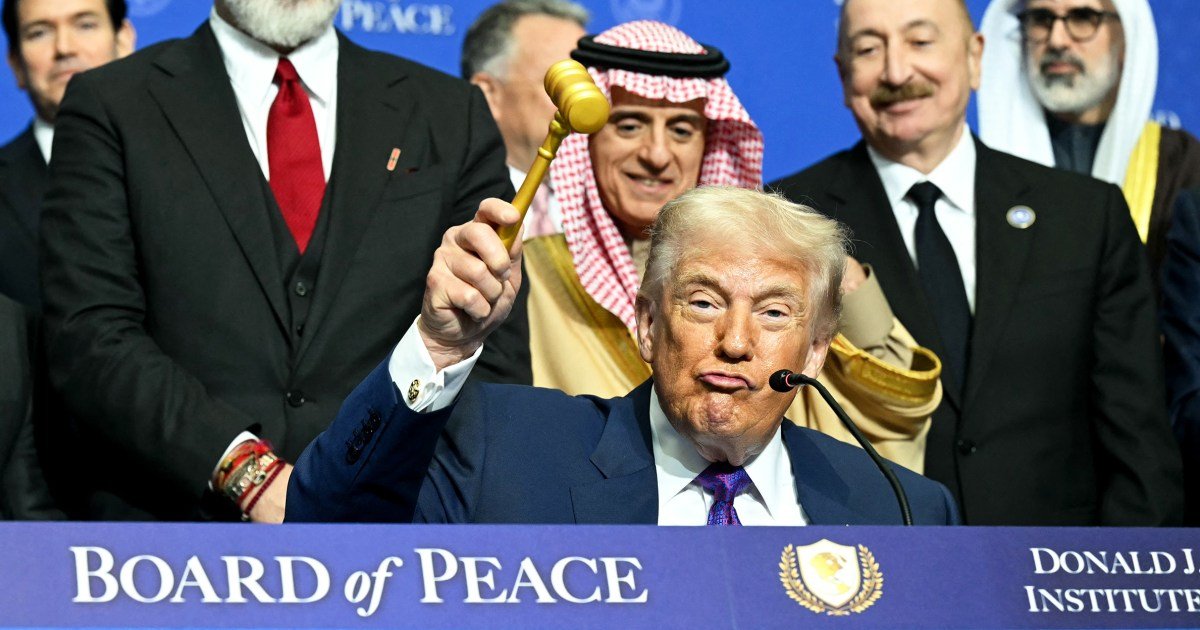
Billions of dollars earmarked for reconstruction and the promise of an international stabilization force for the destroyed Gaza Strip: Those were just two of the promises to emerge from the inaugural summit of President Donald Trump‘s Board of Peace.
“We will help Gaza,” Trump said at the meeting in Washington on Thursday, attended by representatives of more than 40 countries, including several heads of state.
“We will straighten it out. We will make it successful. We will make it peaceful. And we will do things like that in other spots,” he said.
Billions in reconstruction
While Trump initially pitched his board as a body to oversee peace efforts in Gaza, he has since dramatically expanded its remit as a United Nations-style body capable of addressing major conflicts around the world.
Some 27 countries have committed to joining, with Hungarian Prime Minister Viktor Orbán and Argentine President Javier Milei among the world leaders attending. So far, key U.S. allies, including the Britain, France, Norway and Sweden, have declined, some citing concerns the body risks undermining the United Nations’ role in peacekeeping efforts around the world.

Despite the board’s broadened scope, Gaza’s future remained in focus at Thursday’s summit, with Trump announcing that members had committed at least $7 billion for reconstruction of the shattered enclave, with funding promised from countries including Kazakhstan, Azerbaijan, the United Arab Emirates, Morocco, Bahrain, Qatar, Saudi Arabia, Uzbekistan and Kuwait.
Trump separately announced that the U.S. was also committed to dedicating $10 billion to the Board of Peace initiative, though it was not clear where exactly that funding would be allotted.
The billions of dollars earmarked for reconstruction represent a “small fraction” of the roughly $70 billion that a joint estimate from the U.N., the European Union and the World Bank said late last year would be required to rebuild Gaza, according to Julie Norman of Chatham House, a London-based foreign policy think tank.
More than 72,000 people, including thousands of children, have been killed in the enclave, according to the Palestinian Health Ministry, since Israel launched its military offensive. The war followed the Hamas-led Oct. 7, 2023, attacks, in which 1,200 people were killed and around 250 taken hostage.
More than 80% of buildings, including schools, hospitals and homes, are estimated to have been destroyed in the territory, the United Nations Development Programme said last year.
The UNDP’s Special Representative for the Palestinians Jaco Cillers said that at least $20 billion would be needed over an initial three-year period and the rest would be required over a longer time frame.
“I don’t think we should be too optimistic about their ability to change things on the ground very soon,” Norman, an associate fellow at Chatham House’s Middle East and North Africa Program, said ahead of Thursday’s summit.
A central focus of reconstruction efforts when they do get underway will be the rebuilding of Rafah. The city in the southern Gaza Strip bordering Egypt has long been a lifeline for Palestinians and a key portal to the outside world, with a video played at Thursday’s event outlining a three-year goal to rebuild it.
The plan includes building 100,000 homes for 500,000 residents, plus $5 billion in infrastructure funding, he said. Eventually that number would grow to 400,000 homes with more than $30 billion in spending on infrastructure.
Billionaire Yakir Gabay described plans to develop Gaza’s coastline into “a new Mediterranean Riviera with 200 hotels and potential islands,” echoing Trump’s past calls to turn the enclave into the “Riviera of the Middle East.” Gabay, the son of senior Israeli officials, is set to be on the Gaza Executive Board and is leading a reconstruction bid.
Gabay said the plan would be “subject to a full disarmament of Hamas,” a key stipulation and sticking point in ceasefire negotiations as Hamas has not agreed to hand over its weapons. It is not clear when disarmament might happen if at all — and equally unclear whether the stabilization force would be deployed prior to demilitarization.
Israel made clear it wanted full disarmament, including for Hamas to hand over “all of” its weapons, and the dismantlement of the underground tunnel network and weapons production facilities.