

“Good morning to our families and to everyone listening to us on 90.60 FM. Good morning to you all, and welcome to a new day.”
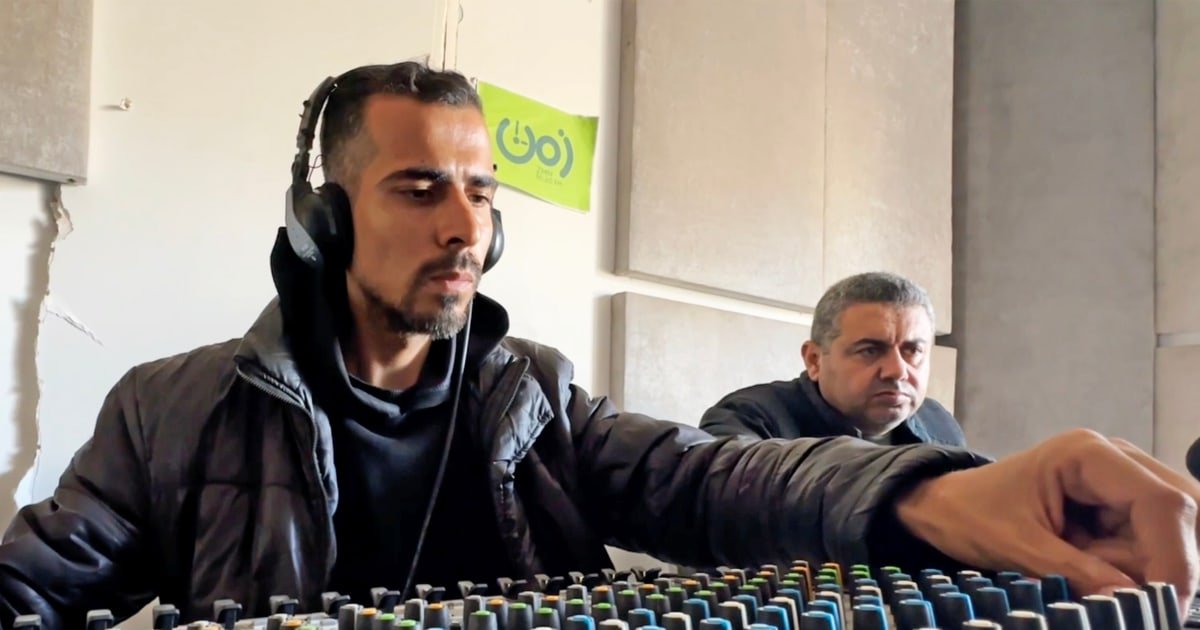
Dr. Rami al-Ashrafi opens his radio show the way countless presenters do around the world, but Zaman FM operates like few others, broadcasting from a building half reduced to rubble in the Tel al-Hawa neighborhood of Gaza City.
The station stays on air for three to four hours a day, depending on electricity, as presenters warn residents about unexploded ordnance hidden in the streets, but also talk about daily life, Ramadan and the price of food.
“A tray of eggs was 25 shekels yesterday, today it has jumped to 90 shekels,” al-Ashrafi tells his listeners on his morning show. “Where is the Ministry of Economy? And where are those in charge of the country?”

Zaman FM was one of the most listened-to independent stations in Gaza, trusted by people because it was not affiliated with any political party, but the station fell silent when war broke out two years ago, as Israel struck Gaza in response to the Oct. 7 terror attacks.
Al-Ashrafi decided to return to the airwaves six weeks ago, as the ceasefire in Gaza continues to largely hold, despite continued Israeli strikes in the war-torn enclave.
Hundreds of people have been killed by Israel since the ceasefire began in October, according to Palestinian health officials, as Hamas and Israel have traded accusations of ceasefire violations.

But local radio stations are transmitting again as part of gradual efforts to revive the media landscape in Gaza, which has suffered the widespread destruction of infrastructure and civilian institutions from Israeli attacks.
With many Palestinians living without reliable communication tools or technology, and as the humanitarian crisis persists, radio is one of the most effective ways of getting key messages out to the public.
Al-Ashrafi has had to improvise. The antenna is mounted on a piece of broken concrete, and the signal reaches less than a mile. It should be on the roof, but the roof has been destroyed. A team of 12 used to work on Zaman FM, including presenters, sound engineers and producers, but now just five part-time volunteers help run the station.

Despite its bare-bones approach, listeners have embraced its return to air.
Zayed Khalil, a Zaman FM listener, said the station had brought back “beautiful memories.”
“It felt like a piece of our old life had come back, a reminder of the better days we once had,” he told NBC News. “From a young age, we would gather around it and listen for hours. We spent time listening to it because we didn’t have a TV, satellite or anything else.”

Khalil said that even younger generations who were more accustomed to digital platforms have also found themselves turning back to radio.
“We wish them all the best and continued success,” he added.
For a third year in a row, many Palestinians living in Gaza are currently observing Ramadan from tents amid the rubble of their former homes, with reconstruction among the monumental challenges that lie ahead for the peace process, as well as securing the demilitarization of Hamas.
Inside the radio station, with cracks in the walls, al-Ashrafi wishes his listeners a “blessed Ramadan.”
“Sometimes we fast through hunger, sometimes through memories, sometimes through the pain of losing loved ones,” he said. “We are here, broadcasting from Gaza.”