

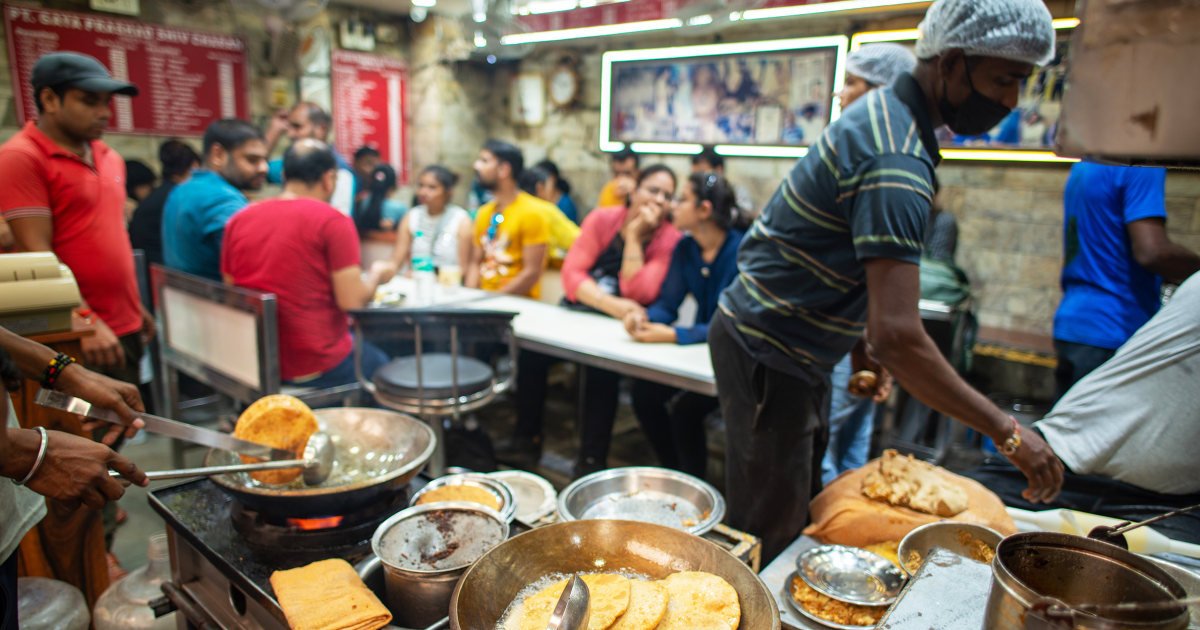
DELHI, India — Abhishekh Dixit’s restaurant has been serving stuffed flatbreads for over a century, relying on gas cylinders to keep the stoves hot and the customers fed.
Subscribe to read this story ad-free
Get unlimited access to ad-free articles and exclusive content.

But those cylinders are in short supply as India’s liquefied petroleum gas imports face the squeeze of the U.S. and Israel’s war against Iran.
“Even in the black market, there is no certainty that I will get any gas or not,” Dixit, 47, said, sitting outside his restaurant, Parawthe Wala, in Delhi’s Chandni Chowk market. “Everything is being affected, and our suppliers have raised prices by up to 5%.”
“It has created an artificial inflation,” he said, with the rising costs forcing him to raise prices himself, while he has also invested in electric stoves in the hopes of making his gas supplies last longer.
There has been no obvious decline in quality, at least. The parathas, as the savory flatbreads are called, stuffed with onion and paneer and coated with a generous amount of butter, are as delicious as ever.
The impact of the war and the subsequent closure of the Strait of Hormuz was almost immediately felt in Asia, which heavily relies on oil and related product exports through the Gulf. The pain has been acute in India, which is the world’s second-largest importer of liquefied petroleum gas after China, with millions relying on gas cylinders for cooking.

FORSUBSCRIBERS

War in Iran is affecting prices in iconic food scene in India
02:05
Over 130 shipping vessels would pass through the waterway daily before the war. Traffic came to a halt when the conflict broke out, with no signs of a large-scale resumption of shipping traffic even after this week’s ceasefire announcement.
Adding to the sense of crisis, many of the workers stranded on tankers in the Persian Gulf are Indians who have been unable to return home.
Though the Indian government attempted to reassure people that there was plenty of supply, panic swept in in the early days of March, with queues for gas pumps and panic-buying.
“I also panicked,” said Dixit, whose restaurant is far from alone in relying on LPG cylinders to keep its operations running.
A large share of that supply comes through the informal market, where prices have soared, he said, if there is availability at all. That extra expense has meant passing on costs to consumers.

Dixit is now charging 110 rupees ($1.20) for a typical paratha, up from 100 rupees before the war, underlining just how much the war’s ripple effects are already hitting ordinary Indians.
A few feet away from Dixit’s restaurant is another renowned for rabri, a sweet, condensed-milk dessert.
On Friday afternoon, its third-generation owner, Utkarsh Sharma, sat behind a mostly empty counter of desserts, not because they were sold out but because he couldn’t secure enough fuel to make more.
“I am facing the full impact,” Sharma, 26, said. “All my work depends on these cylinders.”
His production has dropped by almost 40% since the start of the war, while his costs have risen by a third. “I can’t sustain these prices for longer,” he said, adding that he will have to raise his prices within weeks.
Fuel prices have historically been a sensitive matter for India’s government, which in recent weeks has invoked emergency measures to minimize the impact, including redirecting supplies to emergency services like hospitals.
Indian Prime Minister Narendra Modi has compared the crisis to the Covid-19 pandemic, saying the country was dependent on the Strait of Hormuz for key essentials, including fertilizers.
New Delhi has welcomed the ceasefire, saying the war had “already caused immense suffering to people and disrupted global supply and trade networks.”
“We expect that unimpeded freedom of navigation and global flow of commerce would prevail through the Strait of Hormuz,” the Ministry of External Affairs said Thursday in a statement.

A block away from the alley where Dixit and Sharma operate their businesses, Vinay Chauhan stood behind his street food stall, preparing for the day.
“I’m just borrowing gas from my neighbors and trying to ration,” he said, as he gently stirred oil in the large, shallow frying pan. “The cylinder I am using right now is the one I use at home,” he added.
His signature dish, the popular snack bread cheela, made by lightly frying bread in gram flour, naturally uses less fuel than some treats. “It cooks slowly by the heat of the pan,” he said.
Well aware of price-sensitive consumers’ reliance on LPG, authorities have been pushing for consumers to adopt piped natural gas, including with door-to-door campaigns. The country added over 320,000 new PNG connections in March, India’s oil ministry said in a statement.

Anita Devi has nine people in her family and has not been able to secure gas cylinders for a month. She heard about the authorities’ push for piped connections, and on Friday, she waited outside the gas supplier’s office for her turn to inquire about one.
“I am really worried about the gas supply,” Devi, 45, said.
She’s hoping she can get a pipe connection soon but is fearful about those prices also rising if the war continues.
“I know how to cook over wood. That’s what we’ll do if the prices go up,” she said.