

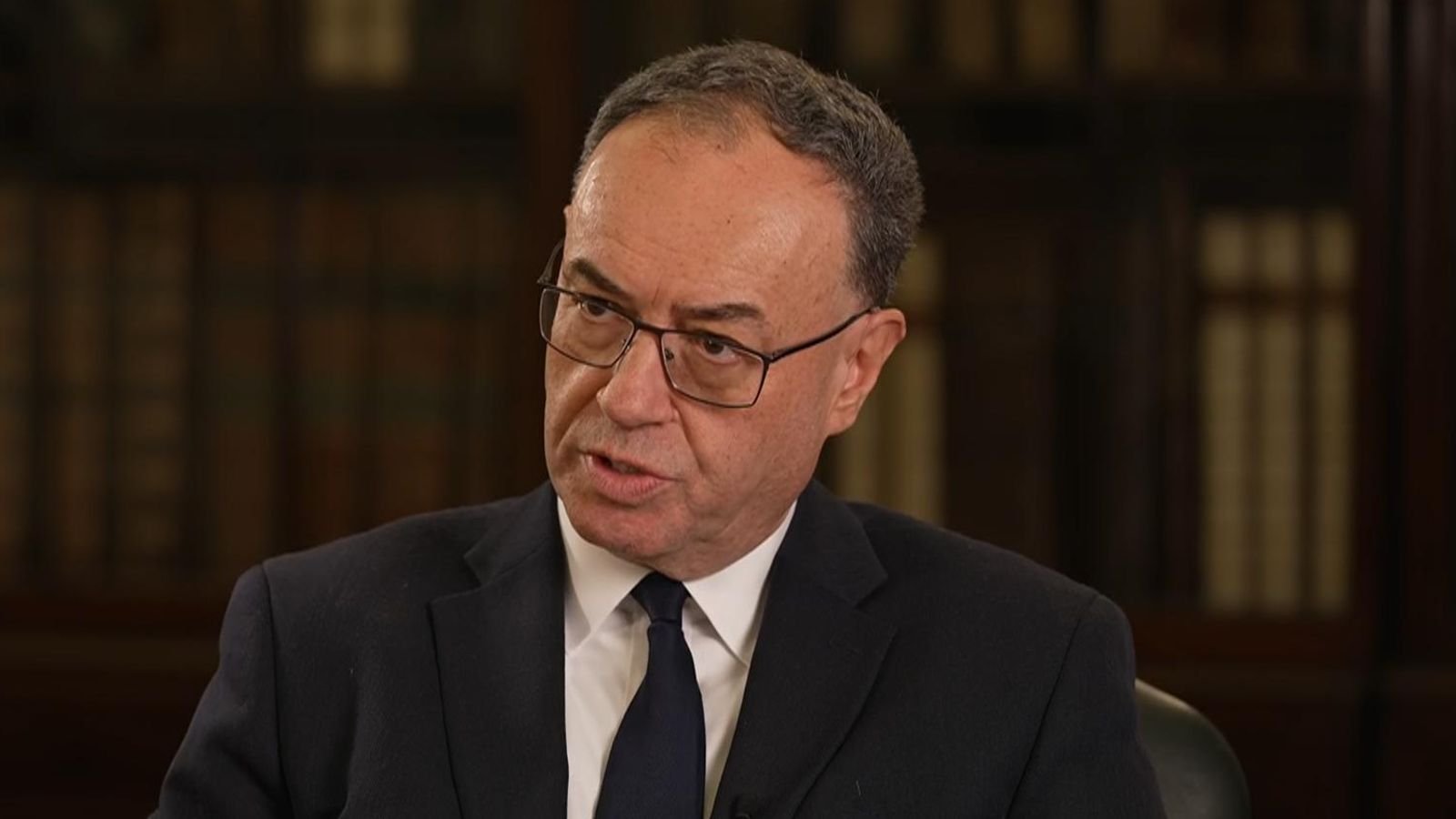
Andrew Bailey, Governor of the Bank of England, is not given to emotional outbursts or shooting from the hip.
Being measured in your public comments is part of the job description for running a central bank, and Mr Bailey has stuck to it since succeeding Mark Carney in 2020.
(To understand the constraints of the job, consider the transformation in the Canadian’s public persona since he swapped Threadneedle Street for his country’s premiership).
Epstein files latest – Andrew’s photo claims undermined
So it felt significant that Mr Bailey should speak with controlled anger – emotion even – when asked by Sky News for his reaction to the revelation that Peter Mandelson was sharing market-sensitive information with Jeffrey Epstein while business secretary in 2008.
“I mean, I am shocked by what we’re hearing. I am shocked by what we now learn about what went on during the financial crisis period.”
That context matters.
Back in 2008, Mr Bailey was part of the bank’s senior management battling, in harness with the Treasury and Downing Street, to prevent the financial system toppling over.
There was the genuine prospect of cashpoints running dry and of governments being unable to sustain the borrowing required to bail them out.
In the UK, ministers and officials pondered selling off state-owned assets worth £20bn to ease the burden, while in Europe, the EU was working on a €500m (£435m) rescue package.
Mr Mandelson allegedly passed details of both to Epstein via email before they were made public, according to Epstein files revelations.
Little wonder that Mr Bailey, a man with a front-row seat on the drama, sounded outraged.
There was a personal edge to his comments, too.
He sounded genuinely emotional when recalling the role of the late Alistair Darling, the then chancellor, working to shore up the economy, and now “unable to speak for himself” about the revelation that a close colleague was undermining him.
The governor’s reaction may also be explained by the fact he is one of the few people in the British institutional establishment with direct experience of challenging Epstein’s circle on their links to the paedophile financier.
Read more on Sky News:
Epstein plan to invest in Fergie brand
King’s silence ‘will frustrate some’
Epstein files: The key findings so far
In 2019, as head of the Financial Conduct Authority (FCA), he approved the investigation of Jes Staley, the American chief executive of Barclays, over his ties to Epstein.
Following Epstein’s arrest, the FCA suspected Mr Staley had not been honest about the extent of their relationship.
Mr Staley was forced to resign in 2020, subsequently banned from holding senior executive position in financial services, and lost an appeal last year in which Andrew Bailey gave evidence.
“I don’t want to sound pious, but this is for all of us – how is it that we live in a society that in which this happened and the cover-up happened as well?” he asked.
In the sorry story of Epstein’s pollution of the British monarchy, politics and the City, he is in a very small club of people whose conduct is entirely vindicated.