

MILAN — For weeks before the Milan Cortina Olympics opened, a central fascination was whether the still-under-construction home of ice hockey, Santagiulia Arena, would be ready.
U.S. men’s players publicly shared little consternation about its condition, perhaps because they had concerns of their own.
Would they be built for this moment, too?
“We feel like we’re the team that came together really quickly,” said forward J.T. Miller. “Feels like we play together year-round, and it’s a good feeling.”
In 24 previous Olympics, the U.S. men have medaled 11 times. But only two of the medals have been gold, in 1960 and 1980. While this team’s ultimate goal may be to replicate the golden feat of the 1980 “Miracle on Ice” team, the U.S. hasn’t medaled on ice, period, since 2010.
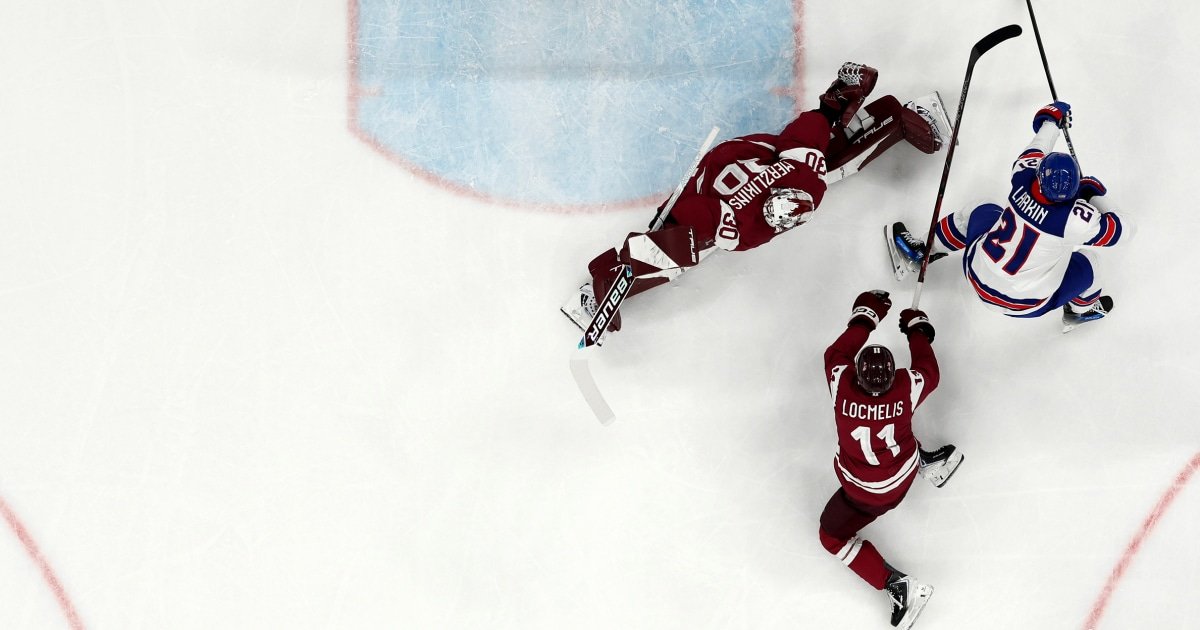
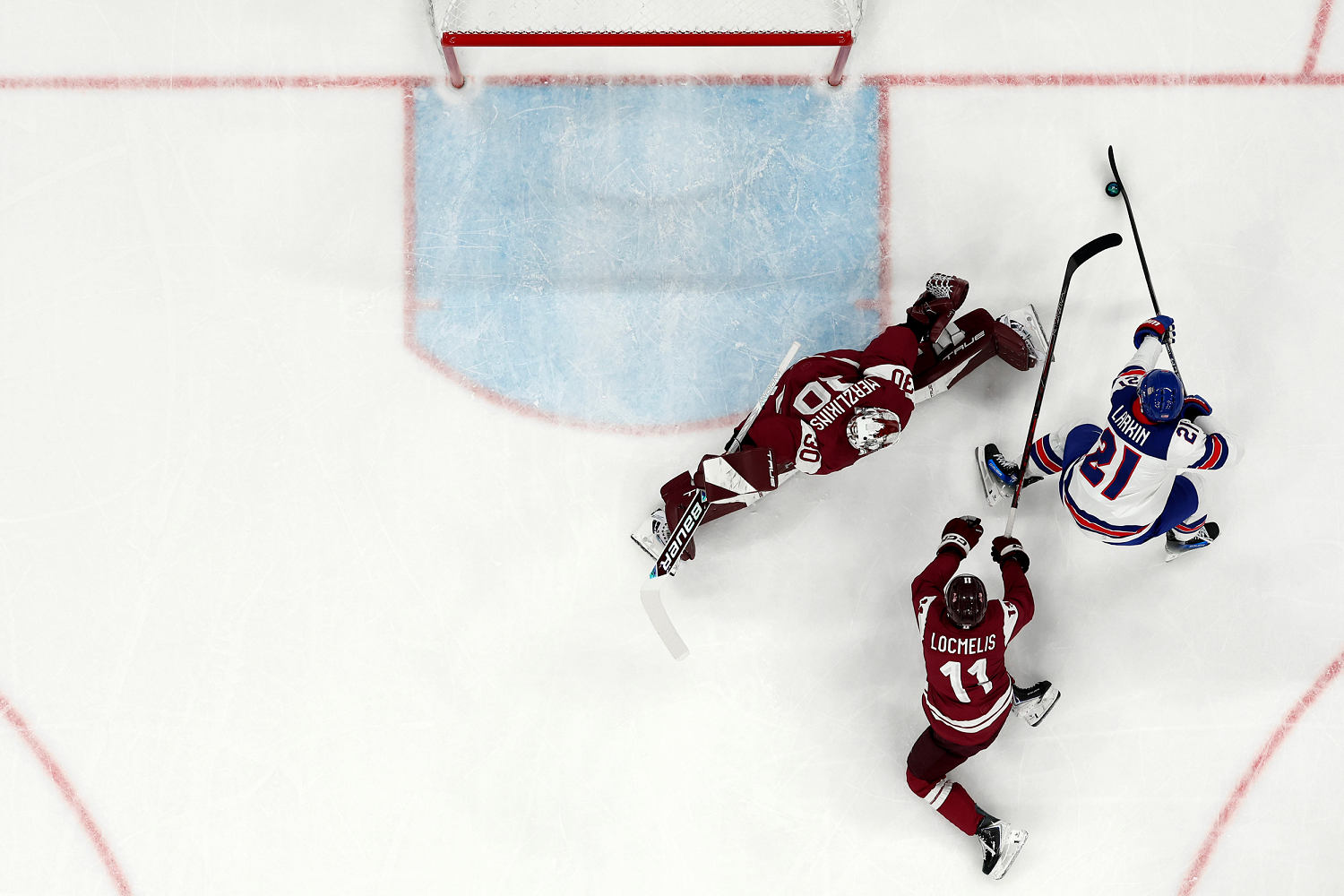
Its pursuit of a medal began Thursday with a 5-1 win against Latvia that belied the game’s slog through the first period and a half.
After Brady Tkachuk’s opening goal five minutes into the first period, assisted by his brother, Matthew — a “memory that’s gonna last a lifetime,” Matthew said — Quinn Hughes added a second goal just 90 seconds later. But when a review for offsides wiped away the score, Latvia answered with its own 30 seconds later.
Later in the period, another U.S. goal was disallowed after Latvia challenged again, this time for goaltender interference. Like the first challenge, the overturned call drew fervent boos in a pro-U.S. crowd at Santagiulia Arena. Despite having doubled Latvia’s number of shots, the U.S had no edge to show on the scoreboard.
By the second period’s end, Latvia’s scare had worn off. The U.S. scored three times in the period’s final nine minutes to break open a 4-1 lead. A scoreboard operator cut to a fan in a maroon Latvian sweater covering his eyes with his palm, unable to watch.
Brock Nelson, whose grandfather Bill Christian played on the 1964 U.S. Olympic team, finished with two goals for the U.S.
In its attempt to break that streak of three consecutive Olympics without a medal, USA Hockey assembled a roster ranked sixth in the world that is the sixth-oldest roster, by average age, in Team USA history. Despite that experience, overall, the roster has seen little of the Games, because this is the first Olympics since 2014 that NHL players have taken part in the Olympics.
Out of 25 players, only defensemen Brock Faber and Jake Sanderson had ever played in the Olympics before Thursday.
“It was pretty special, pretty surreal, definitely feel like I was pinching myself a little bit at times,” Miller said of his Olympics debut. “But we’re here for business, too.”
The U.S. joins Canada and Sweden, the two other heavy favorites to medal, as the only teams made up entirely of NHL players. For the first time since 1964, the U.S. roster includes two pairs of brothers — Brady and Matthew Tkachuk and Quinn and Jack Hughes. Its captain, Auston Matthews, has more NHL goals than any other player since he entered the league a decade ago.
Integrating all that talent has required placing players who have typically been the best on any team they have played on into a hierarchy. Jack Hughes, the first overall pick in the 2019 draft, is on the U.S. fourth line.
“If it’s fourth line, whatever it may be, I’m ready to play that role,” Hughes said. “And you know, when they tap my shoulder, I’m going to be ready.”
Looking down the lineup, he said, “it’s smart hockey guys, and they can read off each other.”
Latvia, the 10th-ranked team in the world hockey federation’s rankings, wasn’t a pushover opponent, despite the U.S.’ nearly 4-to-1 advantage in NHL players. The way the U.S. added four goals in 15 minutes spanning the second and third periods was a reminder of the optimism that has followed the U.S. into these Olympics, despite its struggles since the 2010 Vancouver Games.
It was the U.S., after all, that took Canada to overtime in the final of last year’s 4 Nations Face-Off, the February mini-tournament including Finland, the reigning Olympic champion, and Sweden.
“I feel like we kind of have a little bit of an advantage from the 4 Nations,” said Zach Werenski, whose 62 points this season are second-most in the NHL. “A lot of guys are in similar roles. Everyone understands what’s asked of them.”
Three months after the 4 Nations, the U.S. won the world championship in May for the first time since 1960. Five players from that team are here in Milan, including Werenski. Those experiences have helped the U.S. team quickly microwave its chemistry-building.
“Playing the world championships every year, I don’t want to say you get surprised by other countries, but there’s just a lot of guys you don’t see throughout the season or hear about that don’t play in NHL,” Werenski said. “I know last year we went to overtime with Norway, and Switzerland in the final was a 1-0 game.
“You just kind of get reminded how good other countries are at the sport of hockey and I feel like that showed tonight. Latvia came out really hard in the first period, and you can definitely take moments like the world championships and bring it into this tournament.”
Fans began leaving Santagiulia Arena with seven minutes still to play Thursday. The U.S. will close the preliminary round Saturday against Denmark and Sunday against Germany.