

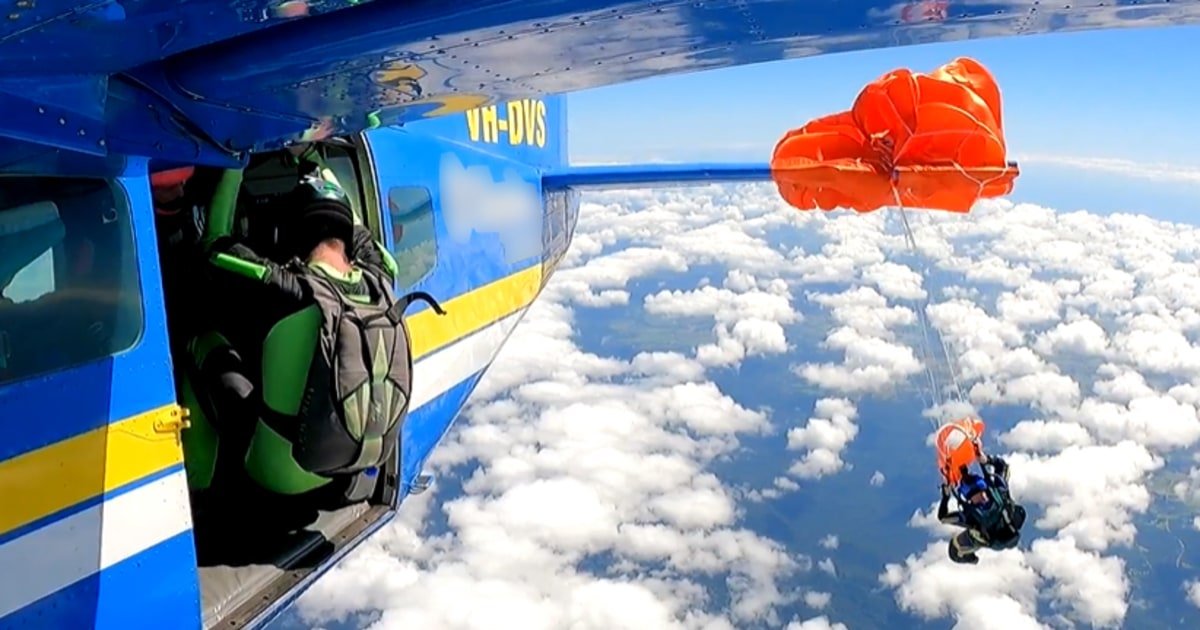
A skydiving trip in Australia took a harrowing turn when one person’s parachute became entangled in the tail of the plane, stranding them at 15,000 feet.
The aircraft, a Cessna 208 Caravan, was carrying one pilot and 17 parachutists, including a camera operator, on Sept. 20 as they attempted a 16-person formation jump over the northernmost part of the state of Queensland.
The camera operator stepped out first, holding on to the fuselage of the plane. When the first skydiver emerged, a handle securing their reserve chute got caught on the plane’s flap over the wing, prompting the chute to deploy inadvertently, according to a video and a report about the incident released Thursday by the Australian Transport Safety Bureau.
The chute dragged the skydiver backward, knocking the camera operator off the plane and into free fall. The skydiver, who has not been publicly identified, flew straight into the plane’s horizontal stabilizer on the left side of the tail, and the chute became wrapped around it, leaving the skydiver suspended.

The pilot, unaware of what had happened, felt the aircraft suddenly pitch up, and noticed the airspeed rapidly decreasing. Believing the aircraft had stalled, the pilot increased power to regain airspeed but reduced it after being told a skydiver was hung up on the tail.
Thirteen other parachutists exited the plane in quick succession, while two remained in the doorway. They watched as the skydiver used a hook knife — which is not mandatory equipment — to cut through 11 ropes connected to the chute, enabling it to tear free in about 50 seconds.
But that was only the first problem.
The skydiver then deployed the main parachute, but it was tangled with the remnants of the reserve chute. The skydiver fell about 7,000 feet from the plane before the main lines fully unwound from the dangling reserve line and functioned normally for the remainder of the descent, the report said.
All parachutists landed safely, including the camera operator and the first skydiver, who sustained minor leg injuries from hitting the horizontal stabilizer.

Meanwhile, the pilot was having control difficulties because the impact of the skydiver had damaged the horizontal stabilizer, which still had part of the reserve chute wrapped around it.
The pilot, who was wearing an emergency parachute, was prepared to bail out from the plane if necessary, but was ultimately able to land safely at Tully Airport, officials said.
According to the report, the Far North Freefall Club, which organized the jump, now requires all parachutists to carry a hook knife.
“Carrying a hook knife — although it is not a regulatory requirement — could be lifesaving in the event of a premature reserve parachute deployment,” ATSB Chief Commissioner Angus Mitchell said, adding that parachutists should be mindful of their handles, especially when exiting a plane.