

The protesters who spoke to NBC News said the crowds chanted slogans including “Long live the shah” and “Down with Khamenei,” referring to the country’s supreme leader, Ayatollah Ali Khamenei. Similar chants can be clearly heard in videos verified by NBC News. In some cases, the protesters set fire to vehicles and buildings belonging to the feared Islamic Revolutionary Guards.
The crackdown was devastating.
At least 6,300 people have been killed, including some 200 security services personnel, according to HRANA. The group which says that it verifies each death with a network of activists on the ground in Iran and that its data goes through “multiple internal checks,” said it is investigating 17,000 additional reported deaths.
Hope and excitement
In Tehran, S., a professional in his 30s who lives and works in Western Europe, took his parents to their first-ever protest on the night of Jan. 8. Home for the holidays when people took to the streets, he said he couldn’t sit on the sidelines.
Hope and excitement filled the face of S.’ 70-year-old father as the family walked into the packed crowd.
Then came the tear gas, S. said, and the family ran to a nearby building sheltering protesters. Security forces chased them, throwing tear gas inside a small room.
“That was one of the very hard moments when I was seeing my mother’s face full of tears,” S. said. “It was really scary.”
In Isfahan, P. was at the front of a protest crowd. It was the night of Jan. 8 and people were hopeful, she said. Then, around 20 to 30 motorcycles pulled up, two people on each bike.
“They just started shooting people straight into their faces and bodies,” she said. As she and a friend sheltered in a lobby of a nearby building later, the injuries she saw were consistent with pellet wounds.
“The lobby was full of blood,” P. said, still haunted by the image. People were doing whatever they could … cleaning and bandaging wounds before heading back onto the street.
P. finally made it back to her apartment safely after hours. That’s when the guilt set in, she said.
“I could hear gunfire after gunfire from my apartment. And I knew with every sound that I’m hearing someone is getting hurt,” P. said.
The following morning, Jan. 9, Khamenei addressed a crowd of his supporters and called the protesters “mercenaries serving foreign powers.” P. said the message was clear and terrifying: The security forces were being given permission to use any means necessary to crush the demonstrations.
Khamenei was telling security forces “you’re allowed to shoot them dead,” P. said.
Despite the clear threat, some of the protesters NBC News spoke to took to the streets again. This time they were met with bullets, not pellets.
“They have guns, but we still went out knowing this because, we said, ‘They’re not going to do this. They’re not going to use guns, real guns,’” she added.
“They were shooting at everyone, anyone they could get their hands on,” K., the 73-year-old, said. “Women, children, men, the elderly, the young, it made no difference to them.”
In Tehran, protesters said they saw snipers on rooftops and mounted machine guns on the backs of pickups.
“They also used heavy machine guns, the ones that have the power to destroy a building, and they’re using them to shoot at people,” S., the young man with his parents, said. “Can you imagine the result?”

Soon, images of hundreds of bodies in body bags began leaking out of the country, despite the internet shutdown and laws banning the sharing of videos related to the protests. NBC News has verified videos of morgues crowded with bodies and distraught families. In some, relatives are seen walking among the black bags, trying to identify the deceased, as wails and screams fill the background.
HRANA estimates that more than 42,000 people have been arrested since the protests began. Human rights groups, including Amnesty International, warn that prisoners are at risk of “arbitrary executions.”
Authorities also introduced sentences of between two and five years for those sending videos to media outlets, Iran’s semiofficial Fars news agency reported earlier this month.
‘Calm before the storm’
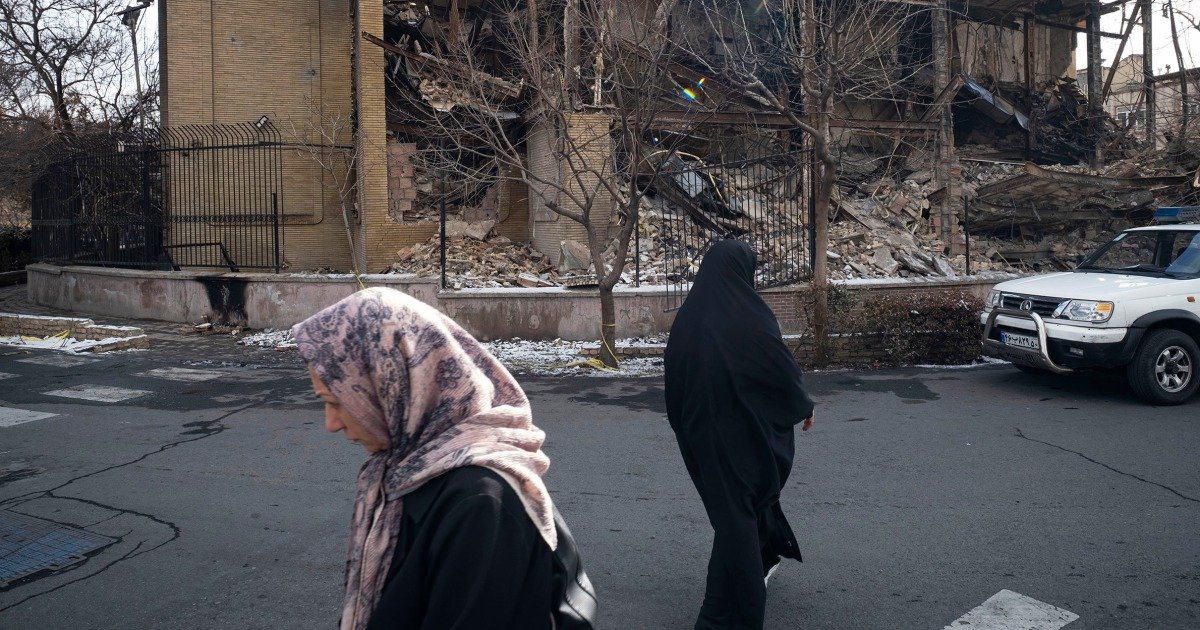
Three weeks after the violence, the country has fallen silent even as the internet sputters back to life. There are no chants, no protests. People are scared, interviewees said, and staying home because of the heavy security presence on the streets, with police checking cellphones for evidence that owners had participated in protests.
“It’s the calm before the storm,” S., a young professional who has taken part in previous protests, said in a voice note from Tehran.
“People are waiting for foreign help to take to the streets again,” she said. “Every family in Iran has someone who has been arrested, injured or killed. You should see the bodies in the streets in those days.”
“It’s horrible,” S. said.
The strikes that Trump promised to protect the protesters never materialized, angering some.
“He incited people, pushed them out into the streets and said he would help,” K., the businesswoman, said.

Recent Trump threats, and the arrival of the USS Abraham Lincoln and other warships in the region, have reawakened the hopes of others.
People like S., the young Tehran native living in Western Europe, have been tracking the ships’ route.
“We’ve done our part,” he said. People “were standing against the bullets, so without any international intervention, I don’t think anyone else is going to do that again because it’s suicide.”